
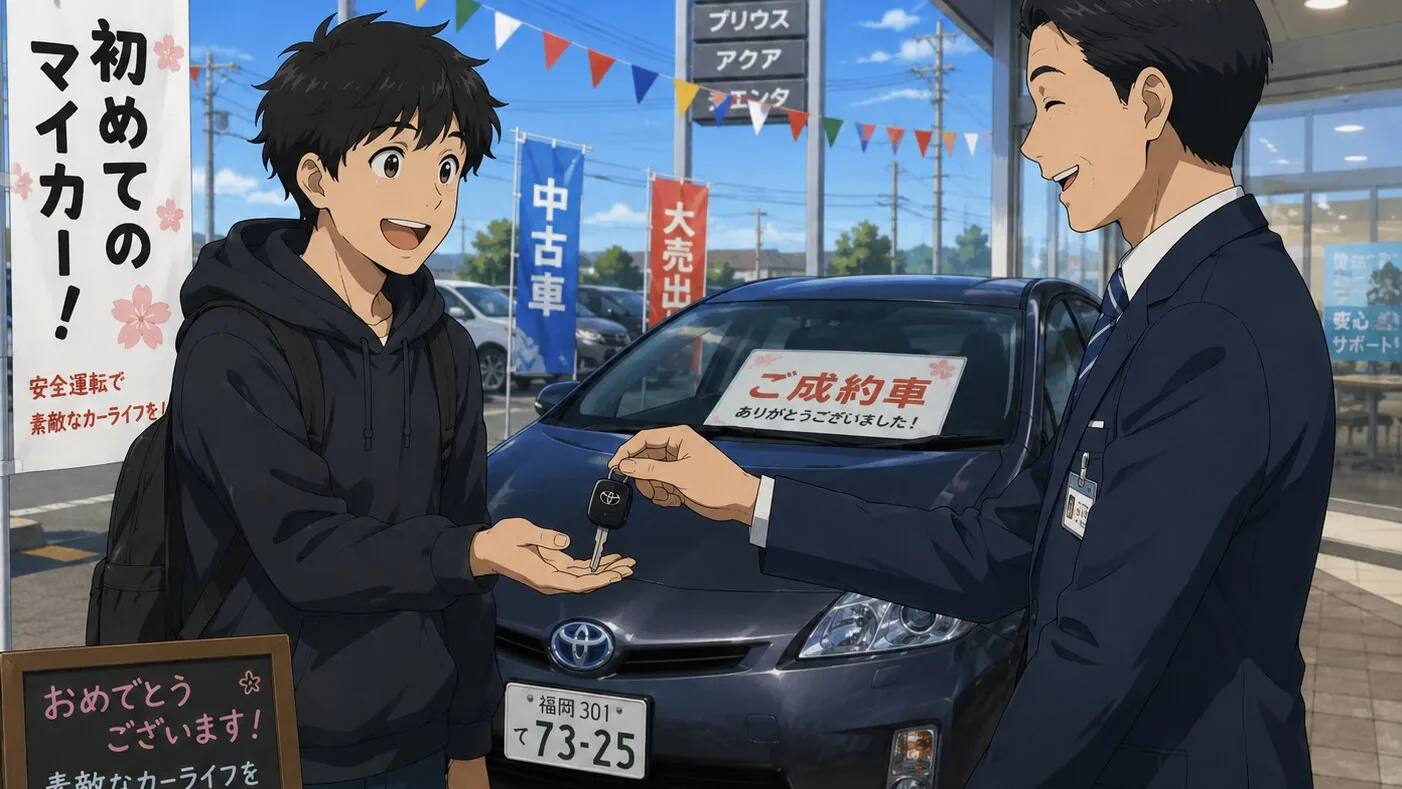
Buying a Car in Japan: What You Really Need to Know
Buying a car in Japan is a completely accessible process, but it involves a number of administrative steps that many foreigners don't know about before they start. And believe me, if you don't have at least an intermediate level of Japanese, it's going to get very complicated quickly.
Why Buy a Car in Japan?
In big cities like Tokyo or Osaka, public transportation is so efficient that a car is often unnecessary, even costly to maintain. But if you live in a medium-sized city, in the suburbs, or in a rural area, a car quickly becomes essential. Used car prices are also very affordable in Japan, sometimes even surprising for a European.
The Inkan and Inkan Shomeisho: The Foundation of Everything
Before even talking about a car, you need to understand a fundamental Japanese reality: the hanko (判子) system, in other words, your personal seal. In Japan, a handwritten signature has no legal value in most important transactions. What matters is your inkan, a stamp engraved with your name that you register at the city hall.
To buy a car, you will need an inkan shomeisho (印鑑証明書), which is an official certificate proving that your seal is registered with your municipality. This document is requested at the city hall of your place of residence, and it generally needs to be renewed regularly as it has a limited validity of three months. Without this document, it's impossible to finalize a real estate or automobile purchase in Japan. It's non-negotiable.
If you haven't registered your inkan yet, that's the first step. Go to your city hall with your residence card (在留カード), your seal, and the corresponding forms. Everything is, of course, in Japanese.
The Shakoshoumei: A Foreigner's Nightmare
This is where many people get stuck, and yet it's mandatory. The shako shomei (車庫証明), literally the "garage certificate," is a document you must obtain from the local police station before you can register your vehicle. This certificate proves that you have a parking space within two kilometers of your home.
To obtain it, you need to provide a map of the parking space, a document proving you have the right to use that space (lease, building owner's attestation, etc.), as well as your exact address. If you are renting and your parking is included in your lease, the landlord will need to provide you with a specific attestation. Everything is in Japanese, the forms are in Japanese, the police station staff speak Japanese.
This document usually takes between three and seven business days to be issued, so plan ahead.
The Shaken: Maintaining Your Car in Japan
The shaken (車検) is the Japanese vehicle inspection, but taken to a level far beyond what we know in Europe. It is mandatory every two years for most vehicles, and it includes a very comprehensive technical inspection, mandatory insurance and tax fees, as well as any necessary repairs to make the vehicle compliant. The cost can easily exceed 100,000 yen depending on the condition of the vehicle. When you buy a used car, always check the date of the next shaken, as it's a determining factor in the real price you pay.
Platforms for Buying
The two main references for buying used cars in Japan are Goo-net (グーネット) and Car Sensor (カーセンサー). You'll find thousands of listings there with all the information on mileage, shaken, vehicle history, etc. There are also auctions through dealers, but those are for more experienced profiles.
And What About Japanese in All This?
Let's be direct: buying a car in Japan without speaking Japanese is extremely difficult. The administrative forms, the exchanges with the police station for the shako shomei, the city hall for the inkan shomeisho, the dealer for the purchase contract, the car insurance... everything is done in Japanese. There really is no alternative, and agencies that offer English support are often significantly more expensive.
This is a reality found in many procedures in Japan: the language is not a plus, it's a necessity.
Learn Japanese Before You Start
If you want to live in Japan, work, rent an apartment, buy a car, or simply navigate daily life without depending on someone else, Japanese is your best investment. And the best way to learn is through daily immersion in the real language, not the one from textbooks.
That's exactly why YumeGO exists. The idea is simple: you watch anime or dramas on Netflix or YouTube, and YumeGO analyzes the Japanese subtitles in real time. You can click on any word to get an instant translation and grammatical analysis, save vocabulary directly from the dashboard as flashcards, and review intelligently without interrupting your viewing pleasure. You learn living Japanese, the kind that people actually use on the street, at work, and in government offices.
In addition to the tool, you join a community on our Discord, where you can ask questions, exchange with other learners, and benefit from personalized support. All for 4.99 euros per month.
If you have a life project in Japan, start now. Every episode watched with YumeGO is one step closer to independence in that country.
Join the community here: https://discord.gg/9z9DgT2cuR
頑張って.
Related articles

Find an Apartment in Japan : Complete Guide 2026
Finding an apartment in Japan can be confusing for foreigners. Learn how renting works, the hidden fees, and why knowing Japanese is essential for living in Japan.

How to Find a Job in Japan (in 2026)
Finding a job in Japan in 2026 can be either surprisingly easy or seriously challenging. It all depends on your Japanese level, visa status, and long-term strategy. Here’s what actually works.

First Trip In Japan
I remember it as if it were yesterday, impossible to forget those sensations.We arrived on February 10th, accompanied by my lifelong partner in crime. The birth date of Japan also happened to be his b...
Find a Share House In Japan
Finding a Share House in Japan:Moving to Japan is an incredible adventure, but one of the first major steps is finding housing. For many foreigners, a share house is the simplest, fastest, and most ac...