
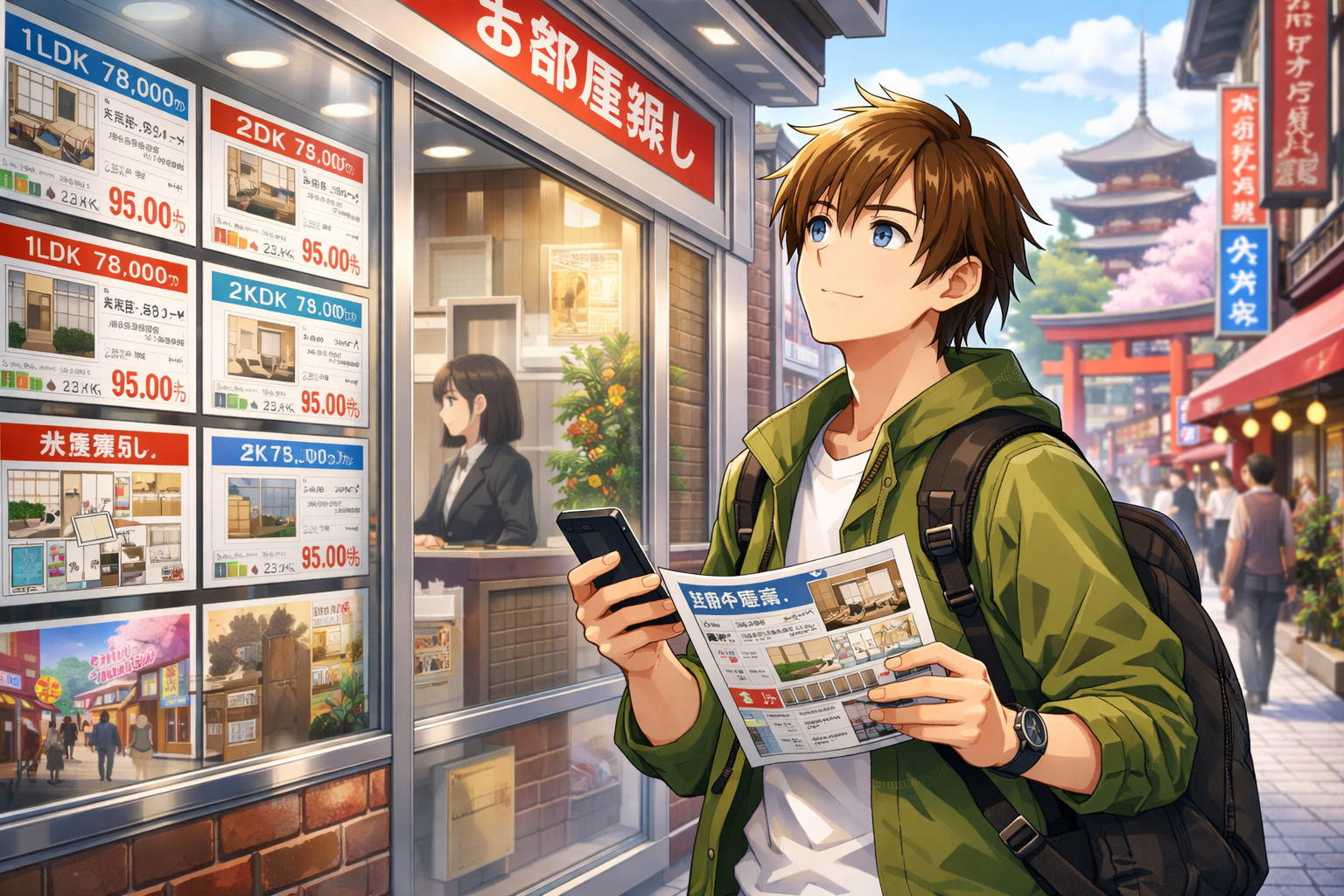
Find an Apartment in Japan: What You Need to Know Before Signing
Renting an apartment in your own country can already be complicated… so renting an apartment in Japan, when you are a foreigner, can be even more confusing.
Between the specific fees, the sometimes different rules, and the documents that are entirely in Japanese, many newcomers feel a bit lost.
But don’t worry: once you understand how the Japanese system works, everything becomes much simpler.
Let’s take a look at what you need to know.
Searching for an apartment in Japan
When you start looking for an apartment in Japan, especially in big cities like Tokyo or Osaka, you will quickly realize something: there are a lot of options.
Sometimes even too many. Obviously, just like in France, the price of a property varies greatly depending on the location, so first of all be curious. You don’t necessarily need an apartment right in the middle of Shinjuku. Japan is huge and beautiful. Personal recommendation: Hiroshima.
Between agencies, real estate platforms, private apartments, and share houses… it can be difficult to find your way.
The main criteria remain the same everywhere:
budget
location
size
distance from the train station
equipment (bathroom, kitchen, washing machine, etc.)
But in Japan, some details are a bit unique.
Location: the key factor in Japan
In Japan, location is extremely important.
The closer your apartment is to a train or subway station, the more expensive it will be. It makes sense: the Japanese transportation network is incredibly efficient, so living near a station allows you to go almost anywhere.
But everyone wants the same thing.
So prices rise quickly.
A common strategy is to live 10 or 15 minutes walking distance from a station, rather than right next to it. Rents can already become much more affordable.
Another important detail: if possible, avoid apartments right next to railway tracks. Trains in Japan are frequent… very frequent.
Understanding apartment sizes
When you look at Japanese real estate listings, you will often see things like:
1K
1DK
2LDK
These letters correspond to the layout of the rooms:
L = living room
D = dining room
K = kitchen
For example:
1K → one main room + kitchen
1DK → one room + dining area + kitchen
2LDK → two bedrooms + living room + dining room + kitchen
But be careful: Japanese apartments are often much smaller than what people expect.
An apartment for one person is often 20 to 25 m².
Another particularity: Japanese people sometimes measure rooms in tatami (畳). For example, a 6 tatami room corresponds to roughly 9 m².
Manshon or Apaato?
Another thing you will often see:
マンション (Manshon)
アパート (Apaato)
Even though the word “manshon” looks like “mansion” in English, it absolutely does not mean a luxury house.
Generally speaking:
Manshon → concrete building, stronger construction, often more recent
Apaato → smaller building, usually cheaper but sometimes less insulated
Manshon buildings are usually quieter and better built.
Fees to expect
This is where many foreigners are surprised.
In Japan, several fees are required when renting an apartment:
Shikikin (敷金)
The deposit. Usually 1 or 2 months of rent.
Reikin (礼金)
The famous “key money”. It’s a gift to the landlord… yes, really. And this money is not refunded.
Agency fees
First month of rent
As a result, when moving in you may sometimes need to pay 4 to 6 months of rent upfront.
So prepare your budget.
Agencies and foreigners
Let’s be honest: some agencies in Japan still refuse to rent apartments to foreigners.
It happens less than before, but it still exists.
Often they require:
a guarantor (often Japanese)
a valid visa
sometimes a minimum level of Japanese
And this is where one detail becomes extremely important.
Japanese is essential
When you rent an apartment in Japan, everything is in Japanese.
The contract.
The building rules.
Administrative documents.
Explanations from the agency.
You will need to:
read a contract
understand the conditions
sign documents
sometimes call the agency or the landlord
There is no way around it.
There are agencies specialized for foreigners, but they are usually more expensive.
The reality is simple: if you live in Japan, Japanese quickly becomes essential.
Learning Japanese to live in Japan
When you live in Japan, Japanese is not only useful for working.
This is exactly why I created YumeGO.
YumeGO allows you to learn Japanese in a natural way, by watching anime or dramas on Netflix, YouTube and other platforms while analyzing Japanese subtitles.
You can:
understand vocabulary used in real life
analyze sentences
save useful vocabulary
improve every day
If you want to live in Japan, Japanese is your best investment.
And daily immersion remains the most effective method.
Conclusion
Renting an apartment in Japan may seem complicated at first, but once you understand how the system works, everything becomes much easier.
The key things to remember:
location is crucial
apartments are often smaller
you need several months of rent upfront
and most importantly… Japanese is essential.
If your goal is to live in Japan long term, start learning the language now.
And if you want to learn Japanese in an immersive way while watching your favorite shows, try YumeGO.
頑張って.
Related articles
Find a Share House In Japan
Finding a Share House in Japan:Moving to Japan is an incredible adventure, but one of the first major steps is finding housing. For many foreigners, a share house is the simplest, fastest, and most ac...
How to Find a Job in Japan (in 2026)
Finding a job in Japan in 2026 can be either surprisingly easy or seriously challenging. It all depends on your Japanese level, visa status, and long-term strategy. Here’s what actually works.
First Trip In Japan
I remember it as if it were yesterday, impossible to forget those sensations.We arrived on February 10th, accompanied by my lifelong partner in crime. The birth date of Japan also happened to be his b...

Find Cheap Hotel In Tokyo
Tokyo has a reputation for being an expensive city. And yet, it is entirely possible to sleep in Tokyo on a small budget, without sacrificing safety or comfort, as long as you know where to look and w...